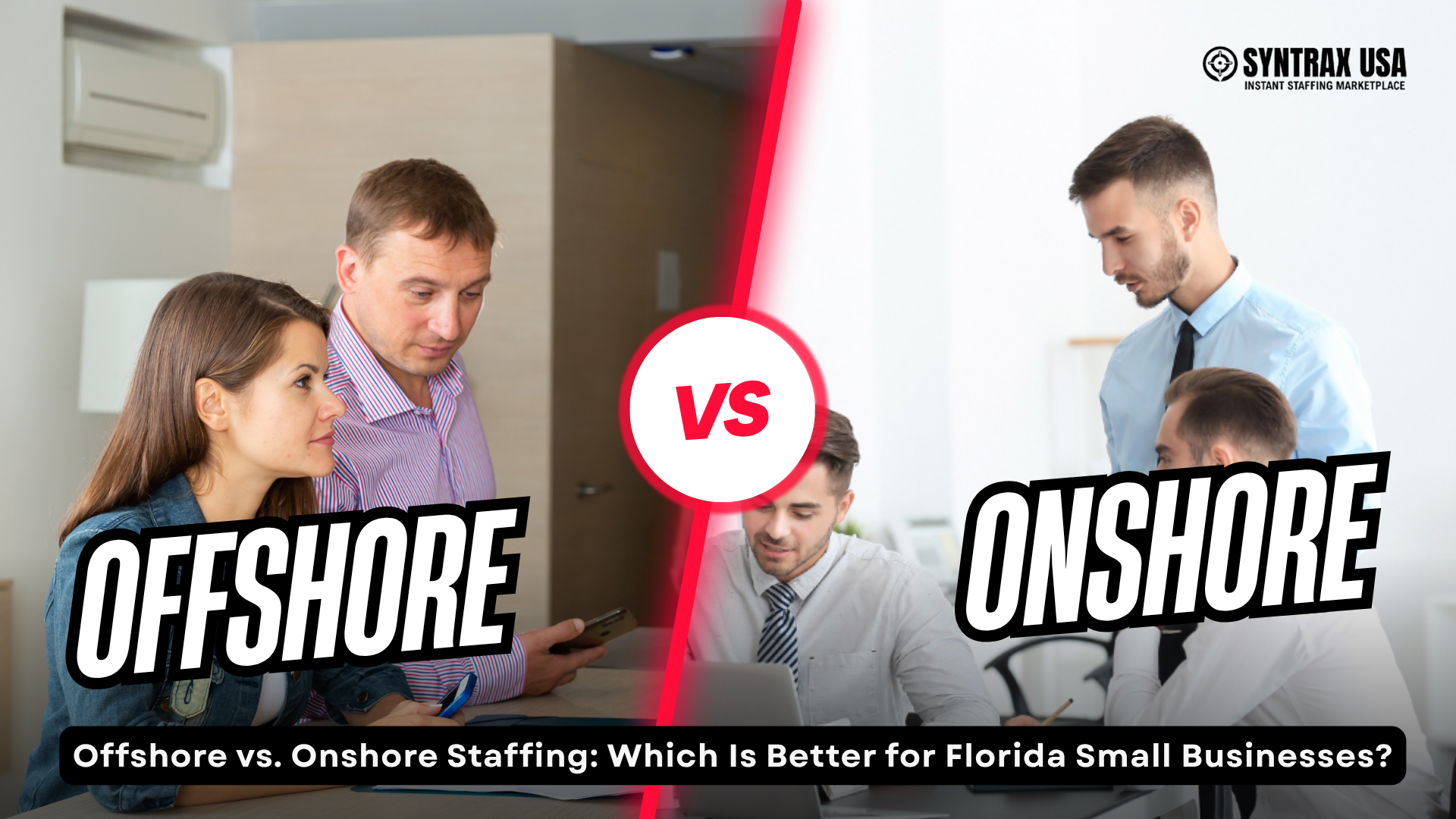
For Florida small business owners, hiring decisions are as strategic as choosing a storefront. One major choice is whether to use onshore (U.S.-based) staff or offshore talent. Each option has advantages and trade-offs—cost, quality, communication, compliance, and cultural fit all matter. This article breaks down the key differences and offers guidance to help Florida small businesses choose the right staffing model for their needs.
Cost and Budget Predictability
Offshore: The most visible benefit of offshore staffing is cost savings. Labor rates in countries like the Philippines, India, and parts of Latin America are often significantly lower than U.S. wages, which can free budget for growth activities—marketing, R&D, or new hires. However, savings can be offset by management overhead, onboarding time, and potential rework if quality or communication issues arise.
Onshore: Onshore staff cost more upfront but typically deliver fewer hidden costs related to cultural gaps, time-zone friction, and rework. For tasks requiring frequent collaboration, the higher hourly rate may be justified by faster turnaround and less project management overhead.
Quality and Skill Fit
Offshore: Many offshore teams have deep technical expertise and excellent English proficiency—especially in fields like software development, customer support, and back-office operations. Reputable offshore firms provide rigorous hiring, continuous training, and dedicated project managers to maintain quality.
Onshore: Hiring locally makes vetting talent and assessing soft skills easier. For customer-facing roles where local knowledge, accent clarity, and cultural nuance matter, onshore staff often provide a superior experience. Likewise, tasks requiring strict adherence to U.S. standards, industry regulations, or close collaboration with executive teams tend to benefit from onshore hires.
Communication and Time Zones
Offshore: Time-zone differences can be an advantage or a challenge. Offshore teams can provide near 24/7 coverage or handle night-shift operations while Florida teams sleep—useful for customer support or monitoring services. However, overlapping work hours are limited, which can slow iterative projects and increase the need for clear documentation and asynchronous communication systems.
Onshore: Being in the same time zone (or within a few hours) simplifies meetings, quick clarifications, and rapid decision-making. For small businesses where owners wear many hats and need immediate answers, onshore staffing reduces friction and accelerates execution.
Legal, Security, and Compliance Considerations
Offshore: Data privacy, IP protection, and compliance (e.g., HIPAA for health-related work) require careful vendor selection and contracts. Offshore vendors can and do meet strict security standards, but you must ensure they have appropriate certifications and clear contractual guarantees.
Onshore: U.S.-based employees and vendors operate under familiar legal frameworks, simplifying compliance with federal and state regulations. Background checks, labor laws, and tax obligations are easier to navigate with local hires.
Cultural Fit and Customer Experience
Offshore: Cultural differences can affect customer service tone, idioms, and expectations. Many offshore teams are trained to match U.S. service standards, but for brands where local authenticity matters—think hospitality, real estate, or local services—onshore staff may deliver a more authentic customer experience.
Onshore: Local hires inherently understand Florida’s market nuances, seasonal cycles (tourism peaks, hurricane season), and regional customer expectations—valuable for businesses that rely heavily on local reputation and repeat customers.
When to Choose Offshore
- You need to scale cost-effectively and handle high-volume, repeatable tasks (data entry, basic customer support, QA).
- You require round-the-clock coverage or want to extend service hours.
- You have robust processes and can manage remote teams with clear documentation and KPIs.
When to Choose Onshore
- Your work requires frequent collaboration, immediate responsiveness, or deep local market knowledge.
- The role is customer-facing where cultural nuance and language clarity are crucial.
- Regulatory compliance and data security are top priorities and you prefer simpler legal oversight.
A hybrid approach: the best of both worlds
Many Florida small businesses find a hybrid model ideal: keep customer-facing, high-touch roles onshore, and move scalable, process-driven tasks offshore. This balances cost savings with quality and responsiveness. Using a trusted partner that offers both onshore account management and offshore delivery can simplify coordination.
Final recommendation
There’s no one-size-fits-all answer. Evaluate the role’s complexity, required responsiveness, regulatory constraints, and your capacity to manage remote teams. For businesses prioritizing local relationships and immediacy, onshore staffing is generally better. For cost-sensitive scaling and repetitive operations, offshore staffing offers strong value. If you want a tailored staffing strategy that aligns with Florida market needs and your growth plan, consider a hybrid model or consult with a staffing partner experienced in blending onshore oversight with offshore delivery—so you keep quality high while optimizing costs.